
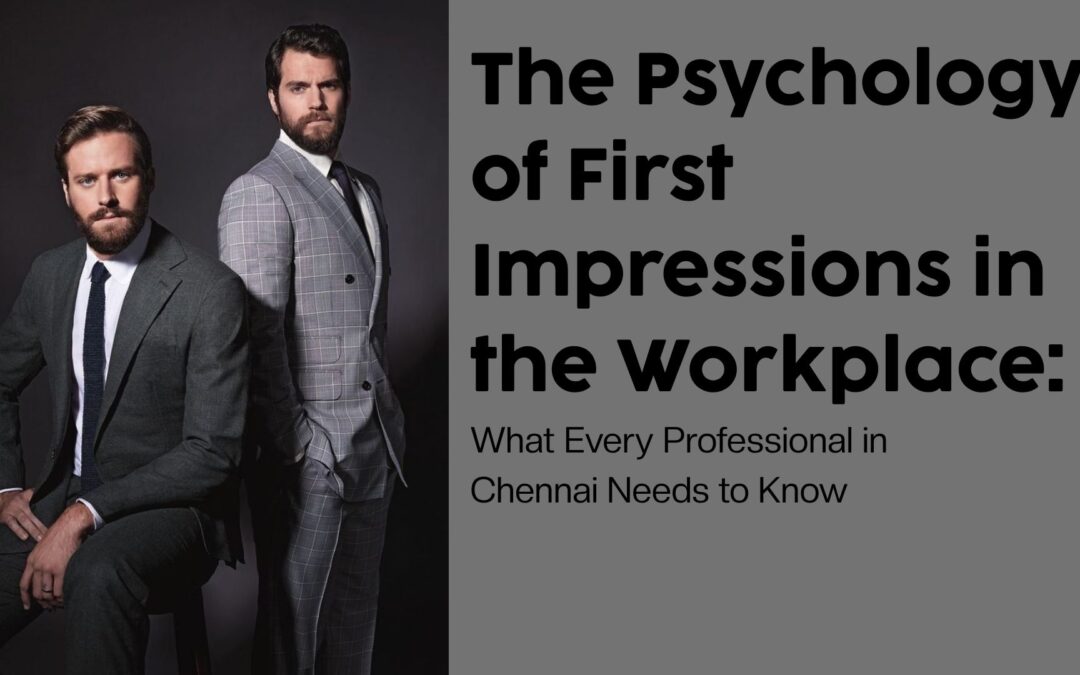
You walk into a boardroom. Before you’ve spoken a single word, before you’ve handed over your business card, before you’ve even taken your seat the people in that room have already formed an opinion about you. Science tells us that this judgment happens in a fraction of a second. Neuroscientists at Princeton University have found that it takes as little as one-tenth of a second for someone to form a first impression based solely on facial appearance.
In today’s hyper-competitive professional environment, where talent is abundant and opportunities are fiercely contested, the ability to make a powerful, positive first impression is no longer just a social nicety it is a strategic career asset.
This is precisely why working with a Personal Branding Consultant in Chennai has become increasingly relevant for executives, entrepreneurs, and emerging leaders. Whether you are a CEO walking into a merger negotiation, a rising manager presenting to the board, or a startup founder pitching to investors, your first impression either opens doors or closes them often before you realize it.
In this comprehensive guide, we will explore the psychology behind first impressions in the workplace, the neuroscience that drives snap judgments, how personal branding directly influences perception, and actionable strategies that CEOs and leaders can use to harness the power of first impressions. If you are looking to elevate your professional presence and build a brand that commands respect, this article is your definitive roadmap.
Contents
- 1 The Neuroscience Behind First Impressions – What Happens in Your Brain in 100 Milliseconds
- 2 The Role of Personal Branding in Shaping First Impressions
- 3 The Seven Dimensions of First Impressions in the Workplace
- 4 The Cost of Poor First Impressions – What the Data Tells Us
- 5 Personal Branding Strategies for CEOs and Leaders – Practical Frameworks
- 6 First Impressions in the Digital Age – Navigating the New Workplace Reality
- 7 Cultural Intelligence and First Impressions in India’s Business Environment
- 8 The Long Game – From First Impressions to Lasting Brand Equity
- 9 How to Choose the Right Personal Branding Consultant in Chennai
- 10 Your First Impression Is Your Brand in Action
- 11 Take the Next Step in Your Personal Brand Journey
The Neuroscience Behind First Impressions – What Happens in Your Brain in 100 Milliseconds
The Brain’s Snap Judgment System
The human brain is an extraordinary prediction machine. Long before we developed language, logic, or reason, our ancestors relied on rapid threat-detection mechanisms to survive. That same neurological wiring still governs how we evaluate other people today only now, instead of assessing whether someone is a physical threat, we are assessing whether they are trustworthy, competent, and worth our time.
The amygdala often called the brain’s “alarm system” processes emotional information and plays a central role in forming first impressions. When you meet someone new, the amygdala rapidly scans for signals of warmth and trustworthiness, while the prefrontal cortex evaluates competence and reliability. These two dimensions warmth and competence form the bedrock of interpersonal judgment, as described in Amy Cuddy’s groundbreaking work in her book Presence and in the Stereotype Content Model developed by researchers Susan Fiske, Amy Cuddy, and Peter Glick.
The Two Questions Everyone Asks Unconsciously
According to social psychologist Amy Cuddy, when we meet someone, we instinctively ask two questions:
- Can I trust this person? (Warmth)
- Can I respect this person? (Competence)
In professional settings, many people make the mistake of leading exclusively with competence listing their achievements, credentials, and expertise before they have established any emotional connection. But research shows that warmth signals are processed first. If someone doesn’t trust you, they won’t care about your competence, no matter how impressive your résumé is.
This is a crucial insight for every personal branding consultant for CEOs and leaders the most effective leaders build trust first and demonstrate competence second. Their personal brand reflects both dimensions simultaneously, creating an aura of confident approachability.
The Halo Effect and Its Professional Implications
The “halo effect” is another powerful psychological phenomenon that shapes workplace impressions. First described by psychologist Edward Thorndike in 1920, the halo effect refers to the tendency for one positive impression in one area to influence overall perception.
In the workplace, this means:
- A well-dressed, confident presenter is assumed to be more intelligent and capable.
- A leader who speaks clearly and articulately is judged to be more trustworthy.
- An executive with polished personal branding is perceived as more successful and visionary.
For CEOs and senior leaders, understanding the halo effect is invaluable. A strong personal brand creates a powerful halo that colors every interaction, every email, every public appearance. This is why personal branding consulting for CEOs in cities like Chennai where business culture blends global professionalism with deep-rooted interpersonal values has become a high-demand service.
The Role of Personal Branding in Shaping First Impressions
What Is Personal Branding, Really?
Personal branding is often misunderstood as simply choosing a professional photograph or updating your LinkedIn profile. In reality, it is the deliberate and strategic curation of how you are perceived professionally, personally, and publicly. Your personal brand is the sum total of:
- The way you dress and present yourself physically
- The way you communicate, both verbally and non-verbally
- Your digital footprint LinkedIn, social media, thought leadership content
- Your reputation within your industry and professional circles
- The values you project and the stories you tell
Jeff Bezos famously said, “Your brand is what people say about you when you’re not in the room.” That statement couldn’t be more applicable in a workplace context. When your name comes up in a hiring decision, a board meeting, or a client conversation, what impression does it evoke?
A skilled Personal Branding Consultant in Chennai helps professionals answer that question honestly and then builds a deliberate strategy to shape that narrative in alignment with their goals and values.
Why First Impressions Are a Personal Branding Issue
First impressions are essentially live personal branding moments. Every time you walk into a new meeting, join a new company, pitch to a new client, or step onto a conference stage, you are broadcasting your personal brand in real time. The challenge is that most professionals leave this entirely to chance.
They assume that their work will speak for itself. They trust that their years of experience will automatically project the authority they deserve. But in practice, without intentional personal branding, even the most talented professionals can appear unfocused, inaccessible, or unremarkable particularly in first encounters.
This is a problem that a personal branding consultant for CEOs and leaders is specifically trained to solve. By analyzing every dimension of how a leader shows up visually, linguistically, digitally, and interpersonally a personal branding consultant builds a coherent, compelling, and consistent impression strategy that works in their favor from the very first moment.
The Chennai Professional Landscape: Why Personal Branding Matters More Here
Chennai is one of India’s most dynamic business cities, home to a thriving IT sector, a growing startup ecosystem, manufacturing giants, and a deeply embedded entrepreneurial culture. The city’s business environment is unique: deeply relationship-driven yet increasingly global in its outlook.
In this context, first impressions carry amplified weight. Chennai’s business culture values respect, credibility, and cultural intelligence alongside professional competence. For leaders operating in Chennai whether heading a mid-sized enterprise or a multinational subsidiary the ability to make a strong impression in diverse settings (from local vendor meetings to global investor calls) requires a personal brand that is both culturally resonant and internationally credible.
A Personal Branding Consultant in Chennai who understands this dual dynamic can help leaders navigate both worlds with ease, making powerful first impressions regardless of the audience or setting.
The Seven Dimensions of First Impressions in the Workplace
First impressions in professional settings are not singular events they are multi-dimensional experiences. Research in organizational psychology identifies seven key dimensions through which we are assessed in the first moments of a professional encounter:
1. Physical Appearance and Grooming
Visual cues dominate first impressions. Studies published in the Journal of Applied Psychology consistently show that physical appearance significantly influences hiring decisions, salary negotiations, and leadership perception. This is not about superficial vanity it is about signal alignment. When your appearance aligns with the role you are claiming, it validates your brand.
For senior executives and CEOs, this means investing in a wardrobe that communicates authority, intentionality, and cultural awareness. It means understanding the power of color psychology how a navy suit projects trustworthiness while red conveys energy and assertiveness. It means ensuring your grooming and personal presentation communicates the level of care and attention to detail that stakeholders want to see in their leaders.
2. Body Language and Non-Verbal Communication
Albert Mehrabian’s much-cited (though sometimes oversimplified) research suggests that communication is overwhelmingly non-verbal encompassing tone of voice and body language more than the actual words spoken. While the precise percentages are debated, the core principle holds: how you say something and how you hold your body while saying it often matters more than what you say.
Power poses, eye contact, a firm handshake, open body posture, and deliberate movement all contribute to first impressions of leadership presence. For CEOs who are preparing for high-stakes presentations or media appearances, working with a personal branding consultant to refine non-verbal communication can be genuinely transformative.
3. Vocal Presence and Communication Style
Your voice is a professional instrument. The pace at which you speak, the modulation of your tone, your use of pauses, your vocabulary choices, and your articulation all shape how you are perceived. Leaders who speak too quickly are perceived as nervous or uncertain. Those who speak with measured confidence are perceived as authoritative and in control.
In Chennai’s multilingual, multicultural business environment, communication style is particularly nuanced. A personal branding consultant for CEOs in Chennai can help leaders develop a communication style that bridges regional authenticity with global professionalism a rare and highly valuable asset.
4. Digital Presence and Online First Impressions
In 2026, first impressions rarely begin in person. They begin online. Before meeting you, a potential client, investor, or board member will likely have Googled your name, reviewed your LinkedIn profile, and consumed some of your public content.
Your digital footprint is your first impression in most professional relationships today. A well-optimized LinkedIn profile, a consistent thought leadership presence, and a coherent digital narrative are no longer optional for CEOs they are foundational personal branding assets.
This is a core area of focus for any serious Personal Branding Consultant in Chennai working with executive clients. The goal is to ensure that what someone finds about you online reinforces and amplifies the impression you make in person.
5. Punctuality and Preparedness
First impressions are also formed through behavioral cues. Arriving on time or better yet, early signals respect, reliability, and professionalism. Coming to a meeting visibly prepared, with clear agendas and relevant data, signals intelligence and leadership competence.
Conversely, arriving late, fumbling with materials, or appearing unprepared creates a negative first impression that can be extraordinarily difficult to reverse. For leaders and CEOs, these behavioral dimensions of impression management are table stakes for effective leadership branding.
6. Emotional Intelligence Signals
How you make others feel in the first moments of an interaction is a powerful dimension of first impressions. Leaders who demonstrate empathy, active listening, genuine curiosity, and social awareness create deeply positive first impressions even when they haven’t said anything particularly impressive.
Emotional intelligence (EQ) is increasingly recognized as a differentiating leadership quality. According to research by TalentSmart, emotional intelligence is the strongest predictor of workplace performance, accounting for 58% of professional success across all job types. When leaders visibly demonstrate high EQ from the first interaction, they create an impression of leadership maturity that is deeply compelling.
7. The Stories You Tell
First meetings often include some form of self-introduction whether formal or informal. The stories you choose to tell in those early moments, and how you tell them, shape impressions profoundly. Leaders who share purposeful narratives ones that communicate their values, vision, and unique perspective create memorable, meaningful first impressions.
A personal branding consultant for CEOs and leaders helps craft these foundational narratives: the elevator pitch, the leadership story, the vision statement, and the professional bio. These stories become the verbal anchors of personal brand, deployed strategically in first encounters to create the impressions that matter most.
The Cost of Poor First Impressions – What the Data Tells Us
Hiring, Promotions, and Leadership Selection
The business cost of poor first impressions is substantial and well-documented. Research from the Society for Human Resource Management (SHRM) indicates that hiring decisions are often made within the first 90 seconds of an interview and most interviewers spend the remaining time seeking confirmation of that initial judgment rather than genuinely reassessing it.
This “confirmation bias” means that a weak first impression doesn’t just hurt you in the moment it can color every subsequent interaction with that person. Psychologists call this the “primacy effect”: the tendency to give disproportionate weight to early information when forming an overall assessment.
For leaders being considered for board positions, C-suite roles, or high-profile speaking opportunities, the primacy effect can be a career-defining force. Those who invest in their personal brand and impression management have a measurable advantage in selection processes.
Client Acquisition and Business Development
In business development, first impressions directly impact revenue. Sales research consistently shows that prospects form impressions of vendors and service providers within the first few minutes of engagement and those impressions heavily influence the final buying decision.
For CEOs who are also their company’s primary brand ambassadors, the connection between personal brand and business outcomes is direct and quantifiable. A CEO with a strong, consistent personal brand builds client trust faster, closes deals more effectively, and generates higher-quality referrals. This is why an investment in working with a Personal Branding Consultant in Chennai is not a personal indulgence it is a strategic business investment with measurable ROI.
Team Performance and Organizational Culture
Leadership impressions also cascade downward into organizational performance. Research in organizational behavior shows that employees form impressions of new leaders within their first few weeks and those impressions shape engagement, trust, and performance for months or even years.
A CEO who makes a powerful positive first impression with their team communicating vision, demonstrating empathy, projecting competence creates what researchers call a “leadership honeymoon effect” that can accelerate organizational alignment and culture-building.
Conversely, a CEO who makes a poor first impression appearing out of touch, arrogant, or uninterested faces an uphill battle rebuilding trust that can take years to overcome, if it is overcome at all.
Personal Branding Strategies for CEOs and Leaders – Practical Frameworks
Framework 1: The Brand Audit Knowing Where You Stand
Before you can improve your first impressions, you need an honest assessment of your current brand. A comprehensive brand audit, conducted with the help of a personal branding consultant for CEOs and leaders, typically examines:
- Digital presence: What does Google return for your name? What does your LinkedIn profile communicate? Are your social media accounts aligned with your professional brand?
- Reputation mapping: What do colleagues, clients, team members, and industry peers say about you? This often requires 360-degree feedback collection.
- Visual identity: Does your physical presentation consistently communicate the leadership positioning you seek?
- Communication audit: How do you show up in meetings, presentations, and media appearances? Are there gaps between your intended message and how you are perceived?
- Content footprint: Are you generating thought leadership content that positions you as a credible authority in your field?
This audit creates a baseline from which a targeted personal branding strategy can be built one that amplifies strengths, addresses gaps, and creates alignment between who you are and how you are perceived.
Framework 2: Defining Your Leadership Brand Archetype
Every great personal brand is grounded in a clear leadership archetype a coherent set of qualities, values, and attributes that define who you are as a leader and how you show up in the world.
Common leadership brand archetypes include:
- The Visionary: Inspires with bold ideas and future-oriented thinking. First impressions should project forward-thinking confidence and intellectual authority.
- The Executor: Gets things done with precision and reliability. First impressions should project preparedness, competence, and focused energy.
- The Connector: Builds relationships and cultures with warmth and empathy. First impressions should project openness, curiosity, and genuine interest in others.
- The Expert: Commands respect through deep domain knowledge. First impressions should project intellectual depth and calibrated confidence.
- The Challenger: Disrupts conventions and drives change. First impressions should project energy, conviction, and courageous thinking.
Most effective leaders blend two or three archetypes. Defining your primary archetype gives you a clear lens through which to align every dimension of your first impression from how you dress to what you say to how you tell your professional story.
Framework 3: The PRIME Method for First Impression Excellence
One practical framework that many personal branding consultants use with CEO clients is the PRIME Method a five-step approach to deliberate impression management:
P — Prepare: Do your homework before every significant encounter. Know your audience, their priorities, their context, and their likely concerns. Preparation projects intelligence and respect.
R — Reflect: Before walking into any important first meeting, take a moment to center yourself. Visualize the impression you want to create and consciously embody the qualities you want to project. Research on “enclothed cognition” (Northwestern University) shows that the simple act of putting on clothing associated with a particular role can shift both your mindset and your behavior.
I — Initiate: Take initiative in first encounters. Introduce yourself first. Offer a genuine compliment or observation. Ask a thoughtful question. Leaders who take initiative in social situations project confidence and social intelligence.
M — Mirror: Practice attentive listening and subtle mirroring reflecting the energy, pace, and communication style of the person you are meeting. Research shows that subtle mirroring builds rapport rapidly and creates feelings of trust and affinity.
E — Elevate: Find a way to leave the other person feeling slightly better about themselves than when you arrived. The most powerful first impressions aren’t created by being impressive they are created by making the other person feel seen, valued, and respected.
Framework 4: Building a Thought Leadership Strategy
For CEOs and senior leaders, thought leadership is one of the most powerful long-term personal branding strategies available. When you consistently publish insightful content whether through articles, speaking engagements, podcast appearances, or social media you build an impressions portfolio that precedes every in-person encounter.
A Personal Branding Consultant in Chennai working with executive clients typically develops a thought leadership strategy that includes:
- A content pillar framework: Three to five core topics that align with your expertise, your industry, and your brand archetype from which all content is generated.
- Platform strategy: A deliberate choice about where to publish and engage (LinkedIn, industry publications, speaking circuits, podcasts, local business forums in Chennai) based on where your target audience spends their time.
- Publishing cadence: A realistic and sustainable schedule for content creation that builds audience expectations over time.
- Voice and perspective: A distinctive point of view that differentiates your content from generic industry commentary the opinionated, experience-grounded perspective that only you can offer.
Thought leadership creates what marketers call “brand awareness at scale” it means that people are forming first impressions of you favorably long before you meet them in person.
Virtual Meetings and the New First Impression Landscape
The rise of remote and hybrid work has fundamentally transformed first impression dynamics. Video calls on Zoom, Google Meet, and Microsoft Teams have created an entirely new set of impression cues and challenges.
Research from MIT and Stanford has examined how video-mediated communication alters perception, finding that several traditional cues (height, physical presence, full-body posture) are eliminated, while others (facial expressions, background environments, lighting, audio quality) are amplified.
For CEOs and leaders accustomed to commanding rooms with physical presence, the video environment requires deliberate adaptation. Key virtual first impression factors include:
- Camera angle and positioning: A slightly elevated camera angle is most flattering and conveys confidence. Looking directly into the camera not at your own image creates the impression of direct eye contact.
- Lighting: Soft, diffused front lighting eliminates shadows and creates a professional, polished appearance. Poor lighting is one of the most common virtual impression killers.
- Background: Your background tells a visual story about who you are. A curated, purposeful background whether a professional home office, a branded backdrop, or a clean, neutral space adds to your first impression. Cluttered or distracting backgrounds subtract from it.
- Audio quality: Poor audio quality is among the fastest ways to erode a first impression in virtual settings. Investing in a quality microphone signals professionalism and respect for the listener’s experience.
- Digital body language: Nodding, leaning forward slightly, maintaining facial expression engagement, and avoiding multitasking during video calls are all components of positive virtual body language.
A personal branding consultant for CEOs and leaders operating in today’s environment must be fluent in both in-person and virtual impression management and help clients build coherent, compelling brands across both dimensions.
LinkedIn as a First Impression Platform
LinkedIn is now the world’s most powerful professional impression-management platform, with over 1 billion members globally. For leaders and CEOs, it is often the primary surface on which first impressions are formed.
Key LinkedIn first impression elements include:
- Profile photo: A high-quality, professional headshot that projects your leadership archetype. Research shows that profile photos with direct eye contact and a slight smile are rated as most competent and trustworthy.
- Background banner: A custom banner that reinforces your brand positioning, areas of expertise, or organizational identity.
- Headline: Not just your job title a value proposition statement that communicates who you serve and the transformation you create.
- About section: A first-person narrative that tells your professional story, communicates your values, and invites connection.
- Featured section: Curated samples of your best work, media appearances, publications, or case studies that demonstrate your expertise and credibility.
- Activity and content: Your recent posts, articles, and comments tell a story about what you care about and how you think a continuous first impression updated in real time.
For a Personal Branding Consultant in Chennai, optimizing a CEO’s LinkedIn profile is often one of the highest-impact early actions in a personal branding engagement delivering immediate improvements in how they are perceived before any other change is implemented.
Cultural Intelligence and First Impressions in India’s Business Environment
The Cultural Context of First Impressions in Chennai
India’s business culture is rich, nuanced, and context-sensitive in ways that have profound implications for first impression strategy. Chennai, in particular, has its own distinct cultural codes influenced by Tamil heritage, Dravidian values, a strong intellectual tradition, and increasing global exposure through its IT and automotive industries.
Understanding these cultural codes is essential for making authentic, resonant first impressions in Chennai’s business environment. Some key cultural dimensions that shape first impressions here include:
Respect for hierarchy and seniority: Tamil business culture maintains significant respect for age, seniority, and titles. Leaders who acknowledge these hierarchies through appropriate greetings, deference to senior members in group settings, and recognition of status make far more positive first impressions than those who ignore or violate these norms.
Relationship over transaction: Chennai’s business culture is relationship-oriented. First meetings are often as much about personal connection as professional business. Leaders who invest in personal rapport asking genuine questions about family, interests, or local context create much stronger first impressions than those who rush to the transactional agenda.
Intellectual credibility: Chennai has a deep intellectual tradition. Leaders who demonstrate genuine knowledge, thoughtful reasoning, and intellectual humility (acknowledging what they don’t know as readily as what they do) are highly respected. Overconfidence without substance is quickly detected and negatively judged.
Humility as a power signal: Unlike in some Western business cultures where overt confidence is the primary currency of leadership, Chennai’s business culture respects a more nuanced form of leadership presence one where confidence is balanced with humility, warmth, and collaborative spirit.
A Personal Branding Consultant in Chennai brings cultural intelligence to these dynamics helping leaders align their brand and impression strategy with the cultural context in which they operate, without sacrificing authenticity or global relevance.
First Impressions Across Generations: Managing Multi-Generational Professional Contexts
Chennai’s workforce spans multiple generations from traditional business families and senior government officials to Millennial startup founders and Gen Z digital natives. Each generation has different first impression expectations and response patterns.
Baby Boomers and older Gen X professionals tend to value formality, credentials, and demonstrated experience as first impression signals. A polished, traditional professional presentation formal dress, respectful language, an emphasis on track record tends to resonate strongly with this cohort.
Younger Millennials and Gen Z professionals tend to value authenticity, purpose alignment, and digital fluency as first impression signals. Leaders who present themselves as genuinely human, mission-driven, and comfortable with digital communication make stronger first impressions with this cohort.
Effective personal branding for CEOs operating across these generational contexts requires a strategic flexibility an ability to adapt the expression of your brand without compromising its core. This is a sophisticated skill that experienced personal branding consultants for CEOs and leaders develop with their clients through deliberate practice and strategic coaching.
The Long Game – From First Impressions to Lasting Brand Equity
Why Consistency Matters More Than Perfection
One of the most important principles in personal branding and impression management is this: consistency matters more than perfection. A single spectacular first impression is valuable. A consistent, reliable, and authentic impression delivered again and again across every touchpoint is transformational.
Brand equity is built over time through the compounding of consistent impressions. Every LinkedIn post, every conference appearance, every client meeting, every media interview, every internal town hall is a deposit into your brand equity account. When those impressions are consistent aligned with your archetype, your values, and your positioning they compound powerfully over time.
This is why personal branding is not a one-time project but an ongoing practice. The most respected CEOs and leaders in Chennai and beyond understand that their brand is a living, breathing asset that requires continuous investment, refinement, and management.
Evolving Your Brand as Your Career Evolves
Personal brands, like careers, need to evolve. The brand that serves a rising manager is different from the brand that serves a divisional VP, which is different again from the brand that serves a CEO, which is different from the brand that serves a board member or public thought leader.
Periodic brand evolution anchored in a consistent core but adapted in expression to match new levels of influence and aspiration is essential for career longevity. A Personal Branding Consultant in Chennai who works with clients across career stages provides enormous value in helping leaders navigate these evolutionary moments ensuring that their first impressions always project the leader they are becoming, not just the leader they have been.
Building a Legacy Brand
The highest expression of personal branding for CEOs and leaders is what might be called a legacy brand a personal brand so strongly associated with a distinctive perspective, a meaningful contribution, and a consistent set of values that it outlives any single role or organization.
Leaders who achieve legacy brands think of the names in your industry that you immediately associate with a particular philosophy, methodology, or movement have created a kind of professional immortality. Their first impressions in any context are amplified by the accumulated weight of everything their name already represents.
Building a legacy brand is a long journey. But it begins, as all journeys do, with a single powerful step and often, that step is working with the right Personal Branding Consultant in Chennai to gain clarity on who you are, what you stand for, and how you want to be remembered.
How to Choose the Right Personal Branding Consultant in Chennai
What to Look for in a Personal Branding Consultant
Not all personal branding consultants are created equal. When evaluating a Personal Branding Consultant in Chennai especially one who specializes in CEOs and senior leaders consider the following criteria:
1. Depth of executive experience: Have they worked with leaders at your level? Personal branding for a CEO requires different tools, sensibilities, and strategic depth than personal branding for an early-career professional. Look for consultants with a proven track record at the executive level.
2. Holistic methodology: The best personal branding consultants take a comprehensive approach addressing digital presence, communication style, visual identity, narrative development, and thought leadership strategy as an integrated system rather than isolated tactics.
3. Cultural intelligence: Particularly important in Chennai’s unique business landscape. A consultant who understands the cultural nuances of South Indian business culture and can help you build a brand that resonates authentically within it is invaluable.
4. Results-orientation: Can they point to tangible outcomes for their clients career advancements, business development results, media coverage, speaking invitations, or other measurable impact? Look for specific evidence of transformation, not just testimonials.
5. Chemistry and trust: Personal branding work requires honesty, vulnerability, and a willingness to examine your blind spots. The relationship between a CEO and their personal branding consultant is deeply personal. Trust your instincts about whether the chemistry is right.
Questions to Ask a Potential Personal Branding Consultant
Before engaging a personal branding consultant for CEOs and leaders, consider asking:
- What is your process for the initial brand audit?
- How do you develop a personal brand strategy that reflects my authentic self rather than a manufactured persona?
- What results have you achieved for other CEOs or leaders at my level?
- How do you address the cultural dimensions of personal branding for the Chennai business context?
- What does a typical engagement look like, and how do you measure success?
- How do you stay current with the evolving landscape of digital personal branding?
The answers to these questions will reveal the depth, authenticity, and strategic rigor of the consultant’s approach and help you make a confident, informed decision.
Your First Impression Is Your Brand in Action
We have covered enormous ground in this exploration of the psychology of first impressions in the workplace. From the neuroscience of snap judgments to the cultural dimensions of Chennai’s business landscape, from practical impression management frameworks to the long-term architecture of personal brand equity the central message is this:
First impressions are not accidents. They are the visible expression of your personal brand and they can be deliberately, authentically, and powerfully shaped.
For CEOs and leaders operating in Chennai’s competitive, culturally rich, and increasingly global business environment, investing in personal branding is one of the highest-return decisions available. It is the difference between being genuinely seen in all your capability, character, and vision and being overlooked despite everything you have to offer.
The professionals who understand this are not leaving their first impressions to chance. They are working with skilled Personal Branding Consultants in Chennai who help them show up, every day, as the leader they truly are.
Your personal brand is your most durable professional asset. Your first impression is its most powerful moment of deployment. Both deserve your full and deliberate attention.
The time to invest in yours is not someday. It is now.
Take the Next Step in Your Personal Brand Journey
Are you ready to transform the first impressions you make and build a personal brand that truly reflects your leadership caliber?
Whether you are a CEO preparing for a major leadership transition, an entrepreneur building your public profile, or a senior leader ready to take your career to the next level working with an expert Personal Branding Consultant in Chennai could be the single most impactful investment you make in your professional future.